
St. Nicholas Catholic Church         412 W. 4th Street               Carver, MN   55315                   952-448-2345

  "A community committed to welcoming, stewardship and evangelizing since 1868."


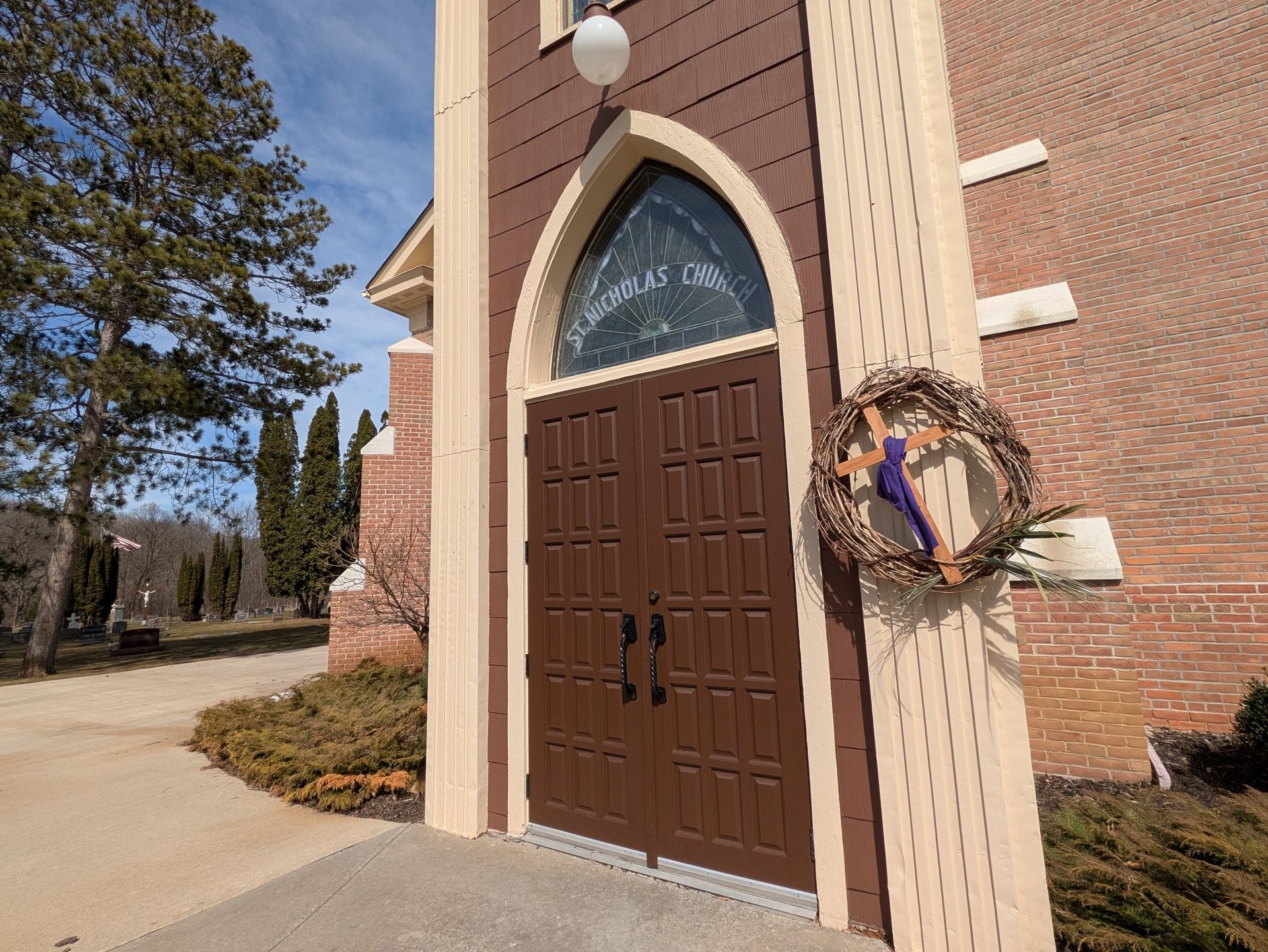
St. Nicholas CatholicChurch

October of 2008


    The Church of St. Nicholas is located on a bluff overlooking the town of Carver and the scenic expanses of the Minnesota River Valley.  From the early 1850's to 1868 the area was a mission territory of the Benedictine priests of Shakopee.  In that latter year Fr. Magnus Mayr, O.S.B was appointed the parish's first pastor.  Under his direction the current church was built, and dedicated on the Feast of St. Nicholas, December 6, 1868.

    A parish school was founded in 1876 and remained in operation until 1917.  In 1973 a Parish Education Center was constructed by parish volunteers under the direction of Fr. Evan Eckdorff, O.E.M., the parish's 28th pastor.  The parish also has two cemeteries, one about a mile west of the church (founded in 1872) and the other adjoining the church (dating from 1935).

    In recent years, the interior of the church has undergone major renovation, and a project to add onto and remodel the old stone rectory has just been completed.

    From 1876 to 1987, the parish was served by Fransciscan priests, either from nearby Chaska or from Sacred Heart parish in St. Paul.  Since 1987 it has been under the pastoral care of diocesan clergy.

    The Parish has an active Parish Pastoral Council, Finance and Property Board and R.E. program, and strong lay involvement in the worship life of the community. 
    ___________________________________________________________________________

    New History Information - July 9, 2009

    Carver and St. Nicholas Church—A Lasting Legacy of Proud and Resilient People

    Carver was and continues to be defined by its location and its resilient people. Throughout its 156-year history, Carver and the faith of its people have been continuously tested. There have been highs and lows. Natural disaster, war and human nature itself have provided great challenges. Yet, despite everything Carver’s colorful history, heritage and faith in God and the goodness of man remains strong.

    It all started back in the 1800s. Carver’s proximity to the Minnesota River made it an ideal navigation and trade center. In fact, it was considered the head of Minnesota-Mississippi River navigation system.

    Despite its bustling river area status, the area was unnamed until 1852. That year, Axel Jorgenson became Carver’s first white settler. He lived here two years and called the area Lukenborg. Others called it Fulton. Neither name stuck.

    The village of Carver was founded in 1852, platted in 1857 and created the township in 1858. Unlike many nearby towns, Carver was not given an Indian name. Instead, Carver was named after its landmarks were cited in the travel documentaries of early English explorer Jonathan Carver. For over a decade, Carver’s boundaries shifted including parts of Chaska and Dahlgren at various times. Carver even made a bid for county seat, which was later awarded to Chaska.

    Carver’s river accessibility made it a prime shopping destination, the Rodeo Drive of Minnesota. Like California, Carver even had its own gold rush in 1858 when gold was discovered in Spring Creek. The rush was short lived as panning proved futile.

    Carver, like the rest of early America, would be greatly shaped by war, the Indian and Civil. The Indian War hit home for Carver pioneers in 1862. The Sioux Indian/U.S. Government land treaty enacted in 1851 gave the Indians millions in exchange for land East of the Red River and Lake Traverse. However, when payments to the Indians were late, resentment soon grew and the Indians attacked the early settlers. Bloody battles ensued, entire families were massacred and throngs of settlers were driven eastward into Carver, Chaska and Shakopee. Generations would talk of those tense days when the good Carver people took in partially clad refugees. Some awaited river transport to Fort Snelling and St. Paul. Others would stay and make their home here, including many veterans of both the Sioux Uprising of 1862 and the Civil War.


    Catholicism Arrives in Carver

    Although the Civil War (1861-1865) battles hit further from home, many of Carver’s own fought bravely for that cause as well. Perhaps lead in part by circumstance and the day’s challenges, certainly by God’s call, religion in Carver soon became a refuge, a necessity. Churches were erected across Carver. Carver’s earliest church, the East Union Evangelical Church was erected in 1858, three years before these historic battles. Other Lutheran churches would soon follow.

    Here’s where history gets muddy. Ancestors of Carver’s first settlers claim the area’s first Catholic church was built in Carver in 1854, four years prior to East Union Evangelical Church and the area’s first Catholic Church, Guardian Angels in Chaska. If true, Chaska residents once traveled to Carver for weekly mass. Although no written documentation can substantiate these claims, missionaries visited Carver occasionally on or before 1858.

    In 1856, a contingency from St. Vincent’s Monastery in Pennsylvania arrived in Carver slating Carver as a potential location for a Catholic institution of higher learning. Years later, the honor later went to Collegeville Township, near St. Cloud, Minnesota, and today’s St. John’s University was born.

    Meanwhile Fathers Demetrius Maronga, Cornelius Wittmann and Bruno Riss of the Benedictine Order, with the help of Fathers George Scherer, Meinulpus Stucenkemper, Magnus Mayr and diocesan priest Reverend William Lette, began establishing missions and churches in Carver and six neighboring counties.

    From 1858-1868, documents show Carver Catholics celebrated Mass and baptisms in private homes, primarily the Martin Steger/Loenard Schroeder house, today known as the Dr. William Griffin House, at the corner of Oak and Fourth Streets in Carver.


    St. Nicholas Church is Born

    On August 30, 1868, St. Nicholas Priest Father Magnus Mayr, from the Order of St. Benedict (O.S.B.) established a board of trustees and building committee to erect a Catholic Church in Carver. The land atop today’s Fourth Street hill, with its sweeping views of the Minnesota River Valley, was originally platted for Carver’s town square. Carver’s downtown later developed at the bottom of the hill for several reasons. Carver founder, Axel Jorgenson built his hotel on already cleared, flat land near fresh water sources prompting other businesses to do the same. Building below the bluff meant businesses had better access to the main “highway”, the Minnesota River, had an easier time building on flat land, meeting prospective customers, loading, unloading and transporting cargo to local businesses, and traveling via horse and buggy. A business district below the hill was born. As a result, Father Mayr was able to secure the land for building Carver’s first documented Catholic Church.

    In what would be considered an act of amazing grace today, Father Mayr together with the Church’s pioneer members including Gottlieb Baer, Louis Bueche, Jacob Bueche, Mrs. Freukes, Martin Freischle, John Gestach, George Guettler, Joseph Hegerle, Mathias Jacobs, Anton Knoblauch, Sebastian Ohnsorg, John Riesgraf, Mrs. Simon Siegle, Martin Steger and Henry Zanger completed Carver’s little church on the hill just before December. That’s just over 2 months from start to finish!

    The original plan for a simple, frame church soon turned into a large, brick building costing $4,000, which likely didn’t include free parishioner labor and any donated or at-cost building materials. The building cost was extremely high considering the average house price in Carver during the 1860s was $250-$350, area farmland cost a mere $1.25/acre, a horse and buggy were $225-$275 and a pound of butter was only 15 cents!

    On December 6, 1868, the Feast Day of St. Nicholas, Father Mayr dedicated the church. Together with 200 pioneer members and the Great Western Band, Father Mayr marched into this grand church and celebrated St. Nicholas Catholic Church’s first mass. Almost simultaneously, John Riesgraf donated land one mile west of St. Nicholas. Consecrated in 1869, the land became St. Nikolas Cemetery (with a German spelling). Today it is called “the old cemetery”, since a new one was created next to the church. An adopted child of founding parishioners Jacob and Genoveva Bueche died in 1869 and was the first to be buried in the cemetery. Three years later, in 1872, Henry Zanger, one of St. Nicholas’ founding fathers and a prominent benefactor and builder, became the first adult buried there.


    St. Nicholas Catholic School Opens

    With Mass now celebrated atop the hill, the Martin Steger/Leonard Schroeder basement at Fourth and Oak Streets in Carver was converted into a makeshift Catholic school. For nearly 8 years, Matthew Tautges instructed area youth on such things as readin’, writin’, rithmatic, and religion.

    In 1876 with funds from Mrs. Suzanna Zanger St. Nicholas Catholic School, today’s Parish office and Rectory, was erected.  When it was built, it was considered a massive space, the native stone building consisted of two classrooms and living quarters for the Sisters of St. Benedict of Shakopee and two Indian orphans. Sisters Augustine, Hyacinth and Anatolia taught until 1881, when Sister Christiania, a Sister of Christian Charity from Chaska’s convent took over.

    The Sisters were true pioneers in the Catholic Church and the field. Life was hard. From 1876-1879, they taught 80 multi-level, multi-aged students. In 1876, there were also an additional 50 pupils for music class. The hardworking sisters also tended a large garden, chickens and cows in the name of self-sufficiency.

    In late 1880, student enrollment peaked at 150 just before Sister Christiana arrived. Then she not only assumed teaching duties, but the fieldwork as well. All this after walking daily from Chaska’s convent for nearly a year!

    Tuition was 75 cents per month, the equivalent of about $12.25 per month in today’s purchasing power. 

    Like those in religious vocations today, the Sisters worked for meager pay. In true community spirit, the congregation believed in the dedication and good work of their Catholic leaders. Thus, they supported the Sisters both financially and physically. The men plowed the large garden, chopped wood and provided janitorial services. The women provided gifts of homemade sausage, apples and vegetables.

    Besides general maintenance, the church structure also benefited from generous St. Nicholas faithful. Around 1880, Mrs. Genoveva Bueche-Kimmel (Kuemmel) funded a bell tower, which was erected shortly thereafter. It still stands tall today.

    In 1882, lay teachers once again accepted teaching responsibilities at St. Nicholas Catholic School.


    Change, Change, Change

    Throughout the years, aesthetic and practical improvements have been made to the church and surrounding land. Surprisingly, the original church structure remains largely unchanged. St. Nicholas has managed to preserve the rock on which its founders built while adapting to the inevitable changes that make the church an even stronger, more beautiful testament of Catholic faith.

    Such changes include the addition of the two side altars, the Stations of the Cross, the sanctuary arch and the stained glass windows during the early 1900s. Cement steps and walks up the jagged terrain from Fourth Street made the church more readily accessible to those living in downtown Carver.

    Although many of the structural improvements remain today, some Catholic practices of ages past do not. As St. Nicholas Priest from 1904-1906 Father Engelhardt Troeskens noted, First Communion age has changed. “The First Communion class for boys and girls was prepared by me and on June 10, they were allowed to receive for the first time, Holy Communion. The age of the children had to be 14 years.”

    The year 1917, marked St. Nicholas’ priestly transition—the Franciscan Fathers from Sacred Heart Parish in St. Paul took over for Chaska’s Franciscan Fathers. Fr. Habig, Fr. Schuluetter and Fr. Brinkmoeller traveled by train from St. Paul to serve St. Nicholas for the next 14 years.

    The school also closed its doors in 1917. At that time, former St. Nicholas School Teacher from 1916-1917, Julia M. Rositch (Diethelm) received $33/month salary in 1916. That’s the equivalent today $534 in today’s dollars. “The next year I received the fabulous sum of $40, a $7 raise. I made out pretty well as my board was only $12 per month,” Ms. Rositch recalled.

    Since closing, the former school has been used for religious instruction and a church office. Before becoming an onsite home for parish priests, a number of parish families charged with church and ground maintenance duties called it home.

    In 1931, St. Nicholas priests once again resided in Chaska. Until a used car was purchased, parishioners took turns driving the priest to and from Chaska.


    St. Nicholas Conducts Aesthetic and Practical Remodels, Honors Servicemen

    In the 1930s, several more improvements made St. Nicholas more accessible and gave it curb appeal. The wide concrete walk leading up to the church and a circular driveway made church access easy. In the late 1930s, Father Jaeger, a diocesan priest at Mound, Minnesota donated ten evergreens, which were dug up and transplanted to their current locations flanking the church. In 1939, a new cemetery adjacent to the church was also prepared. Then and now, burials take place in both the older cemetery west of the church and the new.

    During Father Valentine Scherrer’s tenure as parish priest, improvements continued. A much-needed oil-burning furnace was installed in place of the old coal furnace. Using coal as heat made things interesting. “The parishioners can tell you how they used to take seats near the single vent in the floor above this (the coal) furnace. Apart from the sacristy coal stove, it was the only source of heat in the church. I used to find the Mass wine frozen in the sacristy once in a while and, at times, during Mass I had to look to see if the Sacred Host was actually between my fingers as it was so cold in the church,” Father Scherrer recalled.

    In 1943, St. Nicholas honored the brave parishioners serving in WWII. They included: Clayton Koelfgen, Kenneth Koelfgen, Calvin Schue, John Wherley, Bernard Riesgraf, Clarence Gerold, Charles Dauwalter, Merrill Haase, Gerald Jacobs, Kenneth Dols, Leo Dietz, Anthony Bueche, Raymond Schmidt, Jerome Dauwalter, Leon Dauwalter, George Dietz, Herman Terwedo, Roger Riesgraf, Robert Riesgraf, Leo Scherkenbach, Marian Riesgraf, Joseph Riesgraf, Francis Strobel, Joseph Poppler and James Hron.

    During 1944-1945, Nu-Wood also replaced the wallpaper, an asphalt tile floor was laid, and blonde oak pews replaced the original pews. And in 1952, a newly purchased grand Wurlitzer electronic reed organ added vibrant sound to weekly mass.

    The same year, the former school, ground keepers home and religious instruction site was converted to a parish office and rectory for Father Bertrand Kock, St. Nicholas’ first on-site priest. Parish priests have resided there ever since. This development was perhaps the final sign that Carver’s Catholic Church on the hill was here to stay. But soon enough, Mother Nature would test its resolve and character of its people once again.

    During the early 1960s, the Minnesota River and Carver proper, once heralded for their trade and travel accessibility, experienced a much-needed revival. River regattas and recreational river traffic drew crowds to Carver and, likely, its churches as well.


    Disaster Strikes, Tests Parish and Community Resolve

    Then in 1965, disaster struck. The greatest River Valley flood in history would call into question the survival of Carver itself. A perfect storm of sorts had occurred. For years, the agricultural shift from farming hayfields to small grains and corn left the land vulnerable to flooding. During the fall of 1964, heavy fall rains fell over a frozen ground. Then a record March snowfall and heavy rain preceded a late, and quick, spring thaw. The runoff had nowhere to go but into already high river water. The town was flooded. Similar weather across Minnesota wrecked havoc. Thirty-nine counties, including Carver, were declared disaster areas. And towns everywhere waited anxiously for floodwaters to recede.

    In Carver, an unprecedented disaster forced schools to close for ten days from April 10-20, 1965. Businesses closed too. Carver residents fled up the hill and to neighboring towns. Family and friends took in the temporarily displaced. Never was friendship and community so evident as in those days immediately following the flood.

    Once the water receded, Carver firefighters hosed down all of Carver’s muddy, water damaged homes and town cleanup began in earnest. In late May electric and phone service was finally restored.

    While there were some classes held in previous years, it wasn’t until 1965, several parishioners and Sisters from Guardian Angels Catholic Church in Chaska began the formal St. Nicholas Faith Formation program that still exists today. Classes were held in the rectory, the Church and the Riesgraf farmhouse dining room for several years. In 1967, classes moved to the basement of teacher, Barb Swanson’s home at the corner of Fourth Street and Ash in Carver and continued there for six more years. A dedicated group of early teachers started the tradition of enriching St. Nicholas’ youth with relevant religious instruction and it continues to this day.

    During the three years following the flood, restoring Carver to normal and taking preventative measures toward future flood damage included the construction of a dike. In 1969, Carver’s second highest flood occurred, but with much less damage. Again, its proud people worked hard to restore Carver.

    In 1970, a restored Carver’s proud heritage would be displayed properly with the first annual Steamboat Jubilee. Its main attractions included restored home tours, which recalled Carver’s history and heritage and an antique show. Although its name and attractions have evolved, Steamboat Days has continued yearly ever since.

    St. Nicholas has taken an active part in the celebration from day one. Over the years, parishioners have served food, held craft and baked good sales, conducted raffles and silent auctions, had a petting zoo, even built a float for the annual parade. This church fundraising event has also brought the folks of Carver together for fun, food and conversation.

    In 1971, St. Nicholas received another important facelift. The front right corner of the church was rebuilt; the sanctuary was paneled with dark wood and new carpeting laid throughout the church.


    St. Nicholas Parish Center is Constructed

    In 1973, Father Evan Eckhoff, the Building Committee and parishioners began a new chapter in St. Nicholas history. St. Nicholas’ growth and continued commitment to the advancement of Catholic education and fellowship necessitated a new gathering space, a Parish Center.

    Through an overwhelming response from St. Nicholas parishioners and neighboring communities, St. Nicholas Parish Center was constructed in quick order. It was a group effort. On Saturdays, project leader Oscar “Butch” Reed and a 20-man crew including six cement masons worked tirelessly, while church women provided tasty sustenance. At project completion, Reed estimated that because of quick and dedicated work from the good people of St. Nicholas and the surrounding community, the cost savings totaled almost $35,000!


    St. Nicholas Church Today

    Renovations in the 1970’s were about making life easier for those who served St. Nicholas. Its parish priest was not to be overlooked. As such, 1970s renovations concluded with the construction of a two-car garage outside the rectory in 1978.

    In the 1980s, abundant numbers of faith formation students required an additional gathering space for instruction. Faith formation classes were split between the Parish Center and the lower level of Swanson & Associates office building in downtown Carver. These distant locations weren’t ideal for community building. Consequently, the parish purchased a portable faith formation building that was placed behind the rectory. Several classes, including the Confirmation class, were held there for many years.

    Thirteen years would pass before any more major renovations. During 1991-1992, the church was renovated once again and remains largely the same today. Great effort was taken to preserve and replicate the St. Nicholas of years past. The Church’s original rose-colored wall stencils were discovered under the wall paneling and Nu-Wood. They served as a foundation for the entire redecorating project and were replicated around the sanctuary arch and behind the back altar. The church was painted and recarpeted. Pews were obtained from St. Anne’s Church of North Minneapolis and matching sanctuary altars and lectern were constructed. The original Medallions from the Church’s historic altar were restored and placed on the new altar.

    In 1992, St. Nicholas also joined area churches, including East and West Union Lutheran, for the first ecumenical mass; this tradition of bringing faith-minded people together has since taken place annually on Good Friday and Thanksgiving.

    In 2000, a rectory addition built by many volunteers made priest living quarters larger and more comfortable as well as added a restroom for the office.

    In September 2008, Father Thomas Joseph became St. Nicholas’ 32nd priest. Following in Mother Teresa’s footsteps, with whom he worked for two years, he is reaching out to the entire community. In the first two months, Father Thomas had already visited and had dinner with 45 area families. He has started a popular weekly men’s group “That Man is You,” revitalized the youth group, is organizing a children’s choir, and says a Mass in Spanish weekly at Guardian Angels Catholic Church in Chaska.

    “Whether we have 300 or 3,000 parishioners, every parish has its own unique identity and heritage. I’m asking people to get involved and for their suggestions on how to make St. Nicholas even better. And they’re responding.” Father Thomas Joseph said.


    Our Dedicated Community

    Over the years, the City of Carver has also taken measures to preserve its beauty and rich history. Carver was one of the first historic districts in Minnesota placed on the National Register of Historic Places. Between 1850 and 1925, Carver’s National Register Historic District includes some eighty-seven buildings and four structures that exemplify early river town settlement, commerce, dwellings and architecture. The Heritage Preservation Commission, established in1989, is appointed by the Carver City Council and assists the council and city commissions on historic preservation and related issues. In the summer of 2007, the White House proclaimed Carver a Preserve America Community, the eighth to be so named in Minnesota. Many of its business fronts have been restored with local buff-colored brick and historic facades. Many of the houses and other historic landmarks, including the Church by the River and the railroad water tower, have also been restored. And several developments both south of downtown and atop the hill have taken root.

    Like the river, which ebbs and flows, townsfolk have come and gone. But the indelible impressions left by Carver’s residents, a community spirit and a town proud of its history and heritage remain.

    So does St. Nicholas Church. Yes, it’s undergone numerous facelifts, but through War, through the Great Depression, through the Floods of 1965 and 1969, through more recent challenges within the larger Catholic Church, and worldwide political and economic turmoil, the rock that is St. Nicholas, Carver’s little church on the hill, stands tall. We’re a community rich in faith, dedicated to improving humankind and preserving strong Catholic values, improving our children’s future by carrying out God’s word with relevant messages with the Holy Spirit’s guidance and with fervent dedication.

    It’s time to celebrate in true St. Nicholas fashion. Thanks St. Nicholas for 140 years. May God bless us with many more.


     To see memories from St. Nicholas members - go to the Memory tab